# Bush and the OSRD
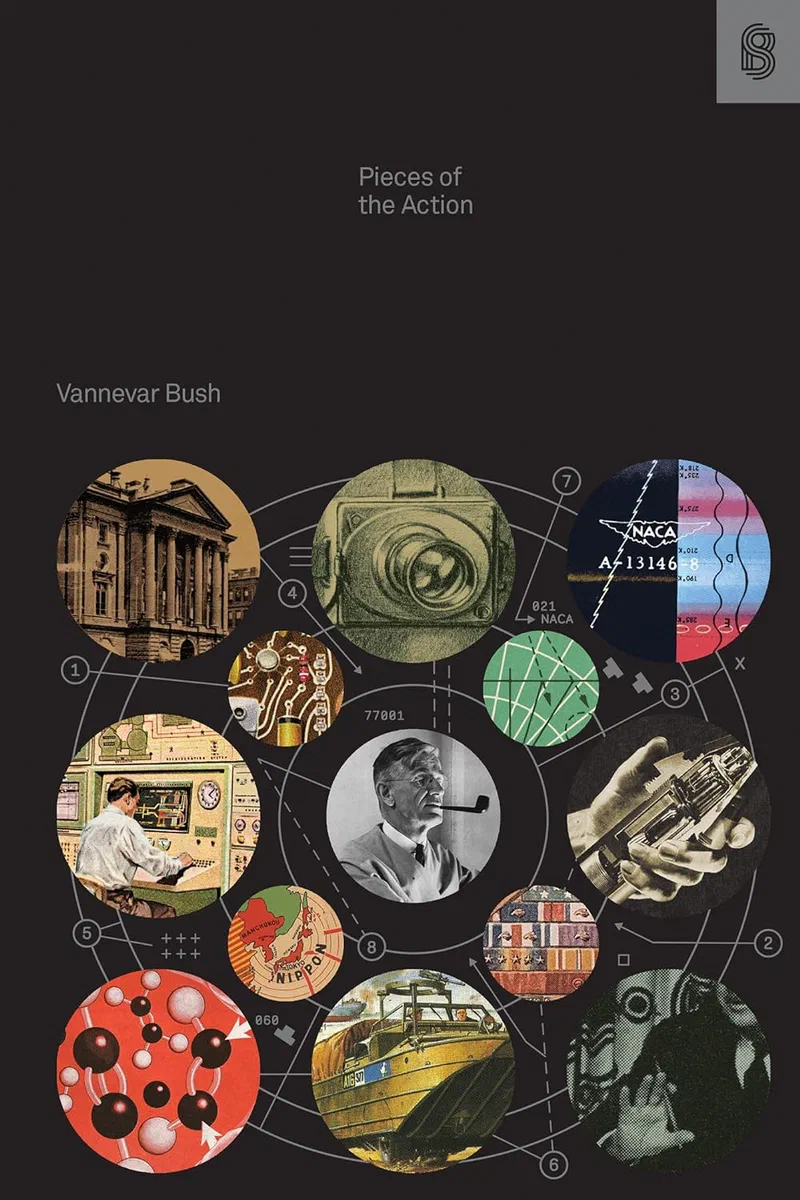
Vannevar Bush ran the Office of Scientific Research and Development (OSRD) during World War II. The OSRD coordinated the American wartime scientific effort between government laboratories, universities, and private industry, operating at a scale and under time pressure that had no peacetime precedent. Pieces of the Action is Bush’s memoir of that work, written as a management manual rather than as a history. It is opinionated and concerned mainly with the practical question of how to run technical people at scale.
# Why R&D is hard to manage
R&D is hard to manage because the goal is not fixed at the start.1 A conventional project can be broken into steps and scheduled. A research project usually cannot. New results reshape the direction, unexpected failures close off promising routes, and the endpoint is often different from the one originally intended.
That same uncertainty is what makes R&D valuable. The technologies that turn out to matter come from work that could not have been planned in advance, which is why R&D is worth doing. The management problem is how to allow enough slack for the unexpected to happen without losing all direction.
The scale of modern R&D investment is easy to illustrate. Amazon, Alphabet, Meta, Apple, and Microsoft spent over $200 billion on research and development in 2022 alone. But spending is not the bottleneck. What separates a productive research program from an unproductive one is whether the organization has a working method for deciding which problems to pursue and which to drop.
That method lives in the judgment of experienced researchers and managers rather than in any formal process, which makes it hard to build and harder to transfer between organizations. Companies good at R&D train their people to recognize problems worth working on, to approach them methodically, and to iterate toward solutions. Companies bad at R&D treat research as a budget line and assume that outputs will follow.
# Context and case studies
R&D management is also heavily context-dependent. The traditional project-management constraints of time, cost, and scope (the “iron triangle”) apply to any research project but are not sufficient.2 A project that succeeds on all three can still fail on factors the iron triangle does not measure: team culture, the politics of the stakeholders, the development methodology, and how the work transitions from a laboratory prototype into production.3
What works for one project often does not work for another, because the context differs in ways that cannot be captured by a generic methodology. A manager who wants to apply the lessons of a past success has to identify which parts of the original success were context-dependent and which were not. That separation is itself the skill being applied.
Fields that deal with context-dependent problems, such as law, medicine, and business management, have developed the case study as a way of carrying forward lessons that do not generalize cleanly into rules. The method originated in legal education under Christopher Columbus Langdell.4 5 A case study preserves the context that a general principle would strip out, and lets the reader decide which aspects of the situation are load-bearing and which are incidental.
Pieces of the Action is, in this sense, a case study of the largest coordinated R&D effort in modern history. Bush is not trying to prove a general theory of how research should be managed. He is reporting what he did, why he did it, and what he thought worked. The reader who wants general principles has to extract them, and that is how the book is meant to be read.
# Read it
The wartime R&D effort produced radar, the proximity fuse, guided missiles, jet engines, and the scaled production of penicillin. Bush ran the American side of that effort as head of the OSRD. He was not the inventor of any of these technologies, but he was the administrator who decided what to fund, who should work on what, how the work should be divided between academic and industrial laboratories, and when to push a project from research into production.
The book covers both sides of that job. Bush was an engineer himself, which gives the technical discussion credibility, but the technical material is not what makes the book unusual. The unusual part is the managerial material: specific, opinionated advice on how to run committees, how to work around the politics of wartime bureaucracy, how to allocate research freedom without losing focus, and how to remove people whose arrogance or rigidity slows everyone else down. An entire chapter is dedicated to that last problem, and Bush calls the people in question tyros.
Read it. The technical details are dated, but the management problems are not, and few people have Bush’s combination of first-hand experience with large-scale coordinated research and willingness to be specific about what actually worked.
Wingate, L. M. Project Management for Research and Development: Guiding Innovation for Positive R&D Outcomes; Levin, G., Series Ed.; Best Practices and Advances in Program Management; CRC Press: Boca Raton, FL, USA, 2015. ↩︎
The Standard for Project Management and a Guide to the Project Management Body of Knowledge (PMBOK Guide), 7th ed.; Project Management Institute, Inc.: Newtown Square, PA, USA, 2017. ↩︎
Some would say it is a wicked problem. For more on this, see: Senge, P. M. The Fifth Discipline: The Art and Practice of the Learning Organization, 2nd ed.; Doubleday/Currency: New York, NY, USA, 2006. ↩︎
The Case Study Teaching Method. https://casestudies.law.harvard.edu/the-case-study-teaching-method/ (accessed 2024-08-26). ↩︎
Crowe, S.; Cresswell, K.; Robertson, A.; Huby, G.; Avery, A.; Sheikh, A. The Case Study Approach. BMC Med. Res. Methodol. 2011, 11 (1), 100. https://doi.org/10.1186/1471-2288-11-100 . ↩︎